What I think of Ryan Holiday’s ‘Trust Me, I’m Lying’

I’ve just finished what I have to get done before tomorrow and both my kids are still having their afternoon nap. Gold.

After the last post about identity politics I have reflected more on that topic and decided that I’d like to write more about it, as a way of exploring my own ideas and also as defense against anyone who might think I’m not a consistent feminist and/or defender of the marginalised. However, that will have to come later. In this post what I want to do is talk about the work of Ryan Holiday, which I’ve been reading lately as part of my research and teaching in digital media.

In his two books I’ve read thus far Trust me – I’m lying, confessions of a media manipulator and Growth hacker marketing Holiday discusses his own experiences as a strategic communicator for American Apparel and various other brands, authors and movie producers. The former book ‘Trust me’ is a sort of tell all mea culpa that describes how easy it is to leverage status and page hits into the media stratosphere for contemporary media manipulators… it is by far the better book and includes some nicely cynical insights about the state of online news and publishing at the moment. The latter book is more of a ‘how to’ guide for people who want to grow their online presence. It is much shorter, much more ‘instrumental’.

So yes, Holiday has, in one book, decried the easy and lasting corruption of digital media platforms and in the other, he’s written about how to make the most of it. He doesn’t come off as too hypocritical, in Trust me, he goes out of his way to identify the actual harm that comes from media manipulation and owns up to damage that he himself has caused… but as he himself notes in the introduction to the updated edition, his exposure of everything wrong with digital media hasn’t changed a thing.

So I think that book is a worthy read for anyone interested in moving into ‘strategic digital media’. It has enough reference to media theory and actual instructive lessons to make it valuable. It is not as good on media theory as something like Pariser’s ‘Filter Bubble’ and it doesn’t really explore the full ramifications of the problems Holiday is uncovering… (which you can read more about in my New Media and Society article on ‘The big data public and its problems’) but it does present some pretty insightful and easy to understand lessons about the digital media industry.

The top thngs I’ve learned from Holiday? That RSS and other syndication models are being phased out of new browsers and operating systems because publishers and editors want you to have to check back on their site all the time (rather than receive notification when something you are interested in has been added – in this way, you create more pageviews and more revenue for the site owner). While this probably won’t seem remarkable to anyone else, I find it a really interesting shift… I’ve always thought Aaron Schwartz (inventor of RSS and reddit) was a visionary and if there is a hope for the internet it comes from the deliberation that engaged communities can generate. The book was also great for outining the economies of supply and demand on websites, which generate the banal and baffling content that you find therein.

It’s also clear that the tail is wagging the dog of public interest and debate… but that’s been true for some time now. Reading Holiday made me more fond of public broadcasting systems and more determined not to use tauel.com to chase traffic but rather to explore important ideas that do not get explored elsewhere.
Identity politics destroys my mind

Recently there was a social media uproar (read: twitter shitstorm) about the fact that the Glastonbury headliners for 2017 are all white males – Radiohead, Foo Fighters and Ed Sheeran. People are up in arms about the fact that this doesn’t represent the true diversity of the music world… I am less sure about condemning Glastonbury because of this choice, partly because I know at least two of these bands are great live acts and a perfect choice for festival goers who expect the headliners of the mainstage at Glasto to be, well, great live acts. While I do reccognise the structural inequality that has led to these acts becoming great, I don’t lament their right to be where they are… and I feel that to do so is actually somewhat unfair. Yes, I am saying white males can be treated unfairly. I am not trying to get ‘in’ with the MRA people, I just really struggle with identity politics.

My colleague and friend warns me not to be ‘white marxist dude’ who reduces all social problems simply down to inequal distribution of wealth and power. I am that guy, to a certain extent. And yes, I’m a rich, white male. So nothing I say from here on in really counts right? As I could never know the pain of structural inequality and I am always passively benefitting from that inequality. I get that, and I acknowledge that it is true. However, I don’t actually think that means that nothing I have to say on the issue could matter.

Structural inequality comes in many, many forms. For instance, among rich, white males, there is a hierarchy of height. Taller men earn more money, have more status and are more likely to find a mate. Similarly, people born to wealthy parents are more likely to be wealthy themselves. Finally, people with anglicised names do better than people with strange names in job interviews, dating sites and promotions. (etc).

Now, as a relatively short man with a very strange name, who didn’t come from an exceptionally privileged background, I have to say that these inequalities are not necessarily determining – I’ve managed to find employment, a mate and some financial comfort despite these things. And I don’t think that is merely because I have had the good luck of being born white and male. My sister, who is notably not male, has had similar successes; and has been coveted by far more employers, more suitors and more accountants than I’ve ever been. And power to her, she’s worked hard for every bit of it. As have I.

Another way of putting it is that I think that everyone is unique, and while we can certainly detect overarching, or ‘molar’ systems of inequality (and unfairness should be battled wherever possible) our identity should never be reduced to those overarching ‘molar’ categories.

One of my go-to people on this topic is Hannah Arendt.  In The Human Condition and ‘Reflections on Little Rock’ she advanced a highly controversial interpretation of identity politics. She urged everyone to feel pride in and celebrate the things that made them uniquely who they were but, at the same time, felt that the things which make us who we are ‘never condition us absolutely’ (HC, p.11). Now, she was a Jewish woman who fled the Germans and saw many of her friends and colleagues killed in the process. When asked to report on the trials of Adolf Eichmann, she demured from her ‘Jewishness’ and instead reported on them as a philosopher. She identified that the underlying mental fault of Eichmann was not that he was monstrous, rather that he was banal.

It is this banality that I see in identity politics – a desire to reject the specific and gravitate toward a global ideal that can be ‘intersectional’ for sure but also demands a deadening of sophistication and the creation of straw men (strawpeople?) for twitter drive-by abuse and social condemnation.  In the end it seems to reduce people back to their identity – and that is not their identity as defined by them and their actions but rather their identity as defined by their skin colour and gender. In prioritising the global and exclusive categories (white, male), as opposed to the global inclusive (human) or specific and local (white, male, middle class, depressive, introverted, arrogant and more) we obscure both the difference we’re trying to celebrate and the REAL systemic causes of exclusion and inequality.

So while no doubt there is something about men generally having less time pressures in their lives, which has allowed more men to experiment with the possibly frivolous pursuit of pop music I have to say that all of those headliners deserve to be there. Choosing to pursue a career in rock is a risky move and there would have been no safety net if they failed…  They have worked hard to get where they are and their hard work (and ability) is what is recognised in the headline slot… not their maleness, not their whiteness. I mean Thom Yorke has facial paralysis, Taylor Hawkins from Foo Fighters battled for a long time with  heroin addiction and Ed Sheeran is a redhead (nuff said). They’ve all known marginalisation and they all make art about resisting it.

So as much as it feels good to condemn people for what they inescapably are, it is, I feel, more instructive to celebrate what they uniquely bring to the world. And in what we can bring, we are actually all inescapably different.


Introduction: Why a website?

This year I’ve started teaching a masters unit in digital media for strategic communciation. I have a massive research interest in the are having written a number of books and academic articles on the issue. However, in order to bring real insight to my teaching and research I thought I ought to re-engage with the practical aspects of maitaining a web presence. When learning the ins and outs of Google Analytics, for example, there is nothing better than having your own account, your own TLD and your own vested interest in doing so!

Having a rather unique name meant that tauel.com was available as a top level domain name and rather than invent some strange portmanteau it seemed logical to get tauel for myself. I’ve been told all my life of various meanings for the word tauel and I thought that the word should have its own space. If you have any ideas about what tauel might mean, I’d love to know.

Of course, the only problem with having a site is that you need to have something on it. So far, that has meant including a few of my favourite photos and a brief run down of things that I’d like to promote to everyone (sort of scream from the rooftops good stuff) and things I’d like to warn people about. I’ve also imported some old html pages from my first attempt at web building in the year 2000. A lot of that content has gone missing but I included everything I could find with minimal effort :).  One of the better parts of that site (and its raison d’etre) was my travel diary from my year of travelling through Asia, Europe and the Americas in 1999… at the time it was the only way of allowing friends I met overseas to keep up with what happened in my travels (no facebook/instagram/flickr back then).  So that’s there too, along with a large pdf file of my first big solo trip in 1996, where I started out going to Thailand and then ended up hitching around Britain and Ireland. On that trip the world didn’t even have internet cafes – and travellers had to talk to each other and make stories instead of constantly updating friends back home. The world was a very different place in 1996.

Back to now, there are, of course, a number of reasons that academics should have a public profile and part of me fantasises about the potential of blogging and sharing information over the net. So I’ve also resolved to blog occasionally to get things off my chest and play around with ideas for research and writing. The hope is that people will engage and respond but if nothing else, it is a space for some venting. While I can’t always guarantee my ideas will be well thought out or articulate, I can promise to be at least as reasonable and informative as Andrew Bolt.

Finally, I’ve set up what I call ‘the ideal speaking space‘ simply as a little experiment. The ideal speaking position is a theoretical concept that establishes the conditions that allow a conversation to be reasonable. I have always wanted to play with that concept on the web, so there it is. As I’m still learning the ins-and-outs of forums it is definitely a work-in-progress… but I hope one day someone will ask a question in that space and we can see how it works.

That’s it really. Hopefully not too conceited and painful. Please let me know if there’s anything you’d like to discuss, or questions we can find the answer to together.


Zombies and Smart Phones

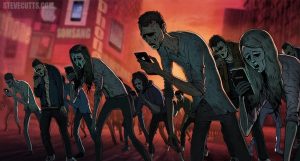
My next book is going to be about critical theory, the internet and smart phones but I intend to also make it about Zombies.


I’ve always been fascinated by Zombie narratives and I’ve made it a bit of a tradition to immerse myself in Zombie films as I grade papers every semester. I enjoy the tropes of Zombie narratives; such as:

  1. The evil corporation or insidious corruption that leads to the development of the Zombie plague
  2. The new materialism of the post apocalypse
  3. The failure to resolve what happens next

As I wrote in a recent article (currently under review) the Zombie narrative is inherently political and gives us a chance to experiment with other ways of living.

So, when I say that I’m writing about zombies and smart phones, I don’t mean this:

Or at least, not only that.

I read once in a National Geographic article that a number of parasites in nature turn their hosts into zombies in order to achieve reproduction. For instance an intestinal parasite that can only reproduce inside a cat’s gut latches onto a mouse or rat and then shuts down the parts of their brain that respond to danger cues (such as the smell of a cat). This makes the mouse so much more likely to be eaten and thus the parasite uses the stupified host for its own purposes.

It’s that sort of relationship I’d like to investigate in terms of smartphones, targeted media, the filter bubble. I have a couple of starting questions to think through:

  1. If smart phones are encouraging us to act in the interest of something other than ourselves, what is that thing? (is it capitalism? consumption? or is it community and social circles?)
  2. What would be the distinguishing features of zombie media use? Alternatively is there a prescritpion for a particularly ‘human’ use of a cell phone?

If you have ideas about the answers to these questions, please let me know.

If you also enjoy Zombie media, I’d recommend ‘Zombies ate my podcast‘ for a very likable podcast focused on discussions of ‘The Walking Dead’ but including coverage of all other zombie media.